Why the Future of Community is Being Served from a Trailer: 5 Surprising Lessons from the Black Sheep Movement

In 2023, the U.S. Surgeon General issued a stark warning: we are in the midst of a "loneliness epidemic." As traditional "Third Places"—those vital community hubs like neighborhood cafes and libraries—decline, our social infrastructure is fraying. This isn’t just a social tragedy; it’s a multi-trillion-dollar business problem. Global employee disengagement costs the economy nearly $10 trillion in lost productivity, driven by a workforce that feels increasingly detached.
On the surface, Black Sheep Brewing Co. is a specialty beverage trailer based in Central New York. In reality, it is a surgical intervention for this disconnection. By leveraging the science of human connection and a lean, mobile business model, Black Sheep is proving that the solution to corporate disengagement and community isolation can be delivered on four wheels.
Here are five surprising lessons from the Black Sheep movement on how to rebuild connection in a disconnected world.
Coffee is Not the Product; It’s the Platform
Most businesses focus on what is inside the cup. Black Sheep focuses on what happens around it. In a world of digital-first interactions, coffee remains one of the few "social scripts"—a universal pattern of behavior that provides physical permission to pause.
Whether it is a high-stakes negotiation or a first date, coffee serves as a "conversational anchor." It offers natural pauses and a shared activity that lowers the psychological effort required to start a conversation. At Black Sheep, the beverage is a catalyst, not a commodity.
Coffee is not the product; it is the platform... it is the vehicle through which we accomplish a much larger mission: creating opportunities for people to connect."
The "Warm Cup" Effect (The Science of Hospitality)
The effectiveness of coffee as a social tool is rooted in Embodied Cognition. This psychological theory suggests that our physical sensations directly shape our social judgments. A landmark 2008 study by Williams and Bargh demonstrated that the simple act of holding a warm beverage makes people perceive others as emotionally "warmer," kinder, and more generous.
Black Sheep uses this to create a Servicescape that fosters Cognitive Ease. By providing a familiar social script in high-friction environments, the trailer reduces the "mental friction" of stressful situations.
In Automotive Dealerships: A warm latte transforms a stressful service wait into a moment of hospitality, making customers more receptive to the brand.
In Hospitals: A brief restorative pause for caregivers and families fosters a sense of being supported during clinical crises.
The Math of "Arithmetic Over Preference"
The Black Sheep movement is built on a superior economic architecture. Traditional brick-and-mortar cafes are "structurally disadvantaged," crushed by high rent and labor. Black Sheep utilizes Contracted Hospitality, where the corporate client—not the consumer—pays for the experience. This model serves as a hedge against the discretionary consumer forecast, converting a revenue "forecast" into a guaranteed "calendar."
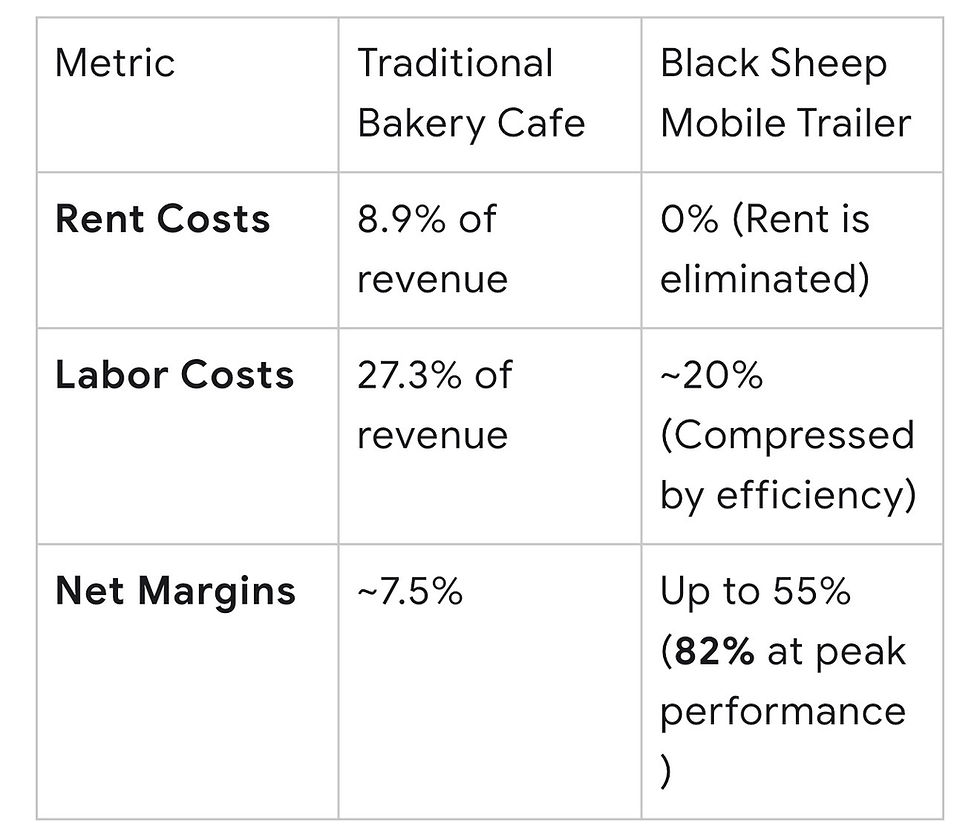
Under this model, a corporate client might book a two-hour event for 999. Serving 50 cups results in a **20 per cup realization**. The client isn't buying caffeine; they are buying an engagement tool that reinforces company culture. This is further validated by structural trends like the "Dirty Soda" movement (e.g., Swig), which signals that consumer demand for premium, customizable beverage experiences is a long-term shift, not a cyclical fad.
Filling the "Gray Space"
True community impact requires addressing the "overlooked middle." Black Sheep defines the Gray Space as the demographic of students and young adults who earn too much to qualify for financial aid but too little to thrive. These students are often caught in a cycle of "grit," balancing full-time studies with the unseen costs of success: car repairs, professional clothing, and grocery bills.
The Black Sheep College Campus Model transforms trailers into "living laboratories." By placing trailers on campuses, the model provides:
Entrepreneurial Experience: Students manage real-world revenue and inventory.
A Safety Net: Direct support for students navigating the "Gray Space" through the future Gray Space Foundation.
"Success is most meaningful when it creates opportunity for others." — Alexandra Elizabeth Freytag, Founder
Trading Transactions for "Emotional Equity"
Traditional marketing is interruptive, but hospitality builds Emotional Equity—an intangible asset and a competitive "moat" that rivals cannot simply purchase with a trailer and an espresso machine. Through Evaluative Conditioning, guests pair the positive emotions of a handcrafted experience with the organization that provided it.
This is best utilized via the Peak-End Rule, a psychological principle stating that we judge experiences based on their most intense point and their conclusion.
The Strategy: If a tedious morning at a corporate seminar or a long wait at a service center ends with a moment of exceptional hospitality at the Black Sheep trailer, the attendee’s memory of the entire day is disproportionately colored by that final, positive peak.
Conclusion: A New Vision for Wellness and Connection
The Black Sheep movement is evolving from a single trailer into a comprehensive Wellness Campus in Clinton, New York. This destination will integrate specialty coffee with movement (Pilates) and recovery (contrast therapy, saunas, and cold plunges).
This ecosystem proves that wellness is not a solo pursuit—it is a byproduct of belonging. Connection is the ultimate competitive advantage. As you look at your own professional or personal life, ask yourself: How am I intentionally creating "Third Place" interactions? In a disconnected world, the most radical thing you can do is invite someone to talk over a warm cup.
Comments